Decking Guide
AZEK vs. Trex vs. Wood Decking
An independent comparison from Triple 3 Construction — a New Jersey builder that installs all three — covering cost, maintenance, lifespan and how each material performs in our coastal climate.


Gray AZEK polymer composite deck with white railings on a New Jersey home
The Short Answer
AZEK is the best choice for New Jersey decks exposed to salt air and heavy weather — its solid PVC core cannot absorb water, so it resists rot, mold and warping the longest.
Trex is the best value for most inland backyard decks and screened porches — wood-like composite looks and performance at a mid-range price, with no annual staining or sealing.
Wood has the lowest upfront cost and the most natural look, but requires the most maintenance and lasts the shortest in our humid, freeze-thaw climate.
Side-by-Side Comparison
How the three materials compare.
| Factor | AZEK (PVC) | Trex (Composite) | Wood |
|---|---|---|---|
| Upfront cost (installed) | Highest — premium capped PVC, typically the most expensive per square foot | Mid-range — below AZEK for most product lines | Lowest upfront — pressure-treated pine is the most affordable |
| Maintenance | Sweep and wash a few times a year — never needs sanding, staining or sealing | Soap-and-water cleaning — no staining or sealing | Regular sealing or staining (often annually) plus board and fastener repairs |
| Typical lifespan | 35–50+ years — a solid PVC core cannot absorb water, rot or splinter | 25–35+ years — capped composite boards resist fading and staining | 10–20 years for pressure-treated lumber with diligent care |
| Moisture & salt-air resistance | Excellent — solid PVC resists water, salt air, mold and mildew | Very good — capped shell resists water intrusion | Most vulnerable — absorbs moisture, prone to rot, warping and fastener corrosion |
| Feel & appearance | Lighter underfoot, crisp routed edges, wide color range | Wood-like texture and grain, most affordable composite look | Natural grain and warmth, but weathers and grays without upkeep |
| Best fit | Shore decks, waterside homes, covered decks with full weather exposure | Backyard decks, screened porches and multi-level builds | Tight budgets, framing and structures where the surface is replaced often |
Lifespans reflect manufacturer guidance and typical installed performance. Costs vary by project size, elevation, railings and site access — request a project-specific estimate.
The Materials


AZEK
AZEK is capped polymer (PVC) decking: a solid, engineered core with a protective polymer cap. Because there is no wood fiber in the board, it cannot absorb moisture — the root cause of rot, swelling and mold.
- Highest moisture and salt-air resistance
- Longest service life and strong warranties
- No staining, sealing or sanding, ever
- Premium price, lighter underfoot

Trex
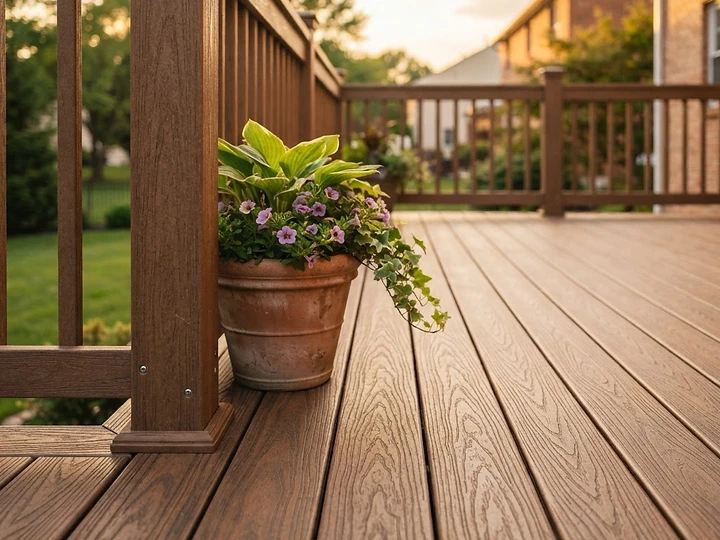
Trex is capped composite decking made from recycled wood fiber and plastic, wrapped in a protective shell. It delivers a wood-grain look with far less upkeep than lumber, at a price below most PVC lines.
- Wood-like look at a mid-range price
- Resists fading, staining and insects
- No annual staining or sealing
- More upkeep-prone near open salt water


Wood
Pressure-treated pine, cedar and hardwoods remain popular for their natural look and lowest upfront cost. Wood framing is still the backbone of every deck we build — the question is what goes on top of it.
- Lowest upfront material cost
- Natural grain, warmth and character
- Requires sealing or staining most years
- Shortest lifespan in humid, coastal NJ
New Jersey Climate
Why climate changes the answer in NJ.


Salt Air & Humidity
Along the Shore, salt spray accelerates fastener corrosion and drives moisture into wood and wood-based boards. Solid PVC boards and marine-grade fasteners hold up longest here.
Freeze–Thaw Cycles
North and Central New Jersey winters move moisture in and out of surface materials. Boards that absorb water — especially wood — crack and warp as that water freezes and expands.
Sun & UV Exposure
Full-sun decks fade and heat up faster. Capped AZEK and Trex products hold their color far better than wood, and lighter colorways keep barefoot-friendly surface temperatures.
Decision Guide
Which should you choose?
Choose AZEK if your deck is at or near the coast, fully exposed to weather, or you want the longest possible service life with the least maintenance.
Choose Trex if you want composite performance and a wood-like look at a lower price, typical for inland backyards, screened porches and multi-level decks.
Choose wood if budget is the priority, the deck is protected or short-term, or you enjoy the routine of annual maintenance — we frame every deck in pressure-treated lumber regardless.
Triple 3 Construction builds covered decks, screened porches and pavilions in AZEK/TimberTech and Trex composites. We are an independent installer and do not claim brand partnerships — we recommend the material each project actually needs.
Explore our Covered Deck Construction servicesFrequently Asked Questions
Is AZEK better than Trex?+
Neither is universally better — they solve different problems. AZEK is solid capped PVC, so it absorbs no water and lasts the longest, which makes it ideal for shore decks and fully exposed structures. Trex is capped composite made partly from recycled materials, costs less, and delivers a wood-like look that performs very well in most backyard settings. For New Jersey homes near salt water, we typically recommend AZEK; for inland decks, Trex is usually the better value.
Is composite decking worth it compared to wood?+
For most New Jersey homeowners, yes. Composite and PVC decking cost more upfront but need no annual staining or sealing, resist rot and insects, and last roughly twice as long as a well-maintained pressure-treated deck. Over the life of the deck, the lower maintenance and longer replacement cycle usually offset the higher initial cost — especially in coastal areas where wood degrades quickly.
How long do AZEK and Trex decks last?+
AZEK decking carries multi-decade warranties and commonly lasts 35 to 50 years or more because its PVC core cannot absorb water. Trex capped composite decking typically lasts 25 to 35+ years. Pressure-treated wood decks generally last 10 to 20 years depending on upkeep, drainage and exposure.
What decking holds up best at the Jersey Shore?+
Capped PVC decking such as AZEK holds up best in salt-air environments. It will not absorb moisture, resists mold and mildew, and its fastener systems are specified for coastal exposure. Pressure-treated wood is the weakest performer near the ocean because moisture drives rot, warping and fastener corrosion.
Which decking needs the least maintenance?+
AZEK requires the least: occasional sweeping and washing with soap and water. Trex is nearly as simple, with the same no-stain, no-seal routine. Wood decking needs the most care — sealing or staining every one to two years, plus periodic board and fastener repairs.
Do AZEK and Trex decks get hot in the sun?+
All decking absorbs heat in direct sun, but lighter colors in both AZEK and Trex lines stay noticeably cooler, and some products are engineered for reduced heat retention. For fully sun-exposed decks in New Jersey, we help homeowners choose lighter colorways and plan shade structures to keep surfaces comfortable.
Do I need a permit to build or replace a deck in NJ?+
Most new decks, covered decks and structural modifications require a construction permit from your local municipality, and some towns also require zoning review. Triple 3 Construction coordinates the applicable documentation and municipal requirements as part of the project. Requirements vary by municipality, so we confirm the specifics for your property before work begins.
Not sure which decking fits your project?
Tell us about your property and we will recommend the right material — and coordinate permits — from day one.
Tell Us About Your ProjectImagery on this page is AI-generated for illustration purposes and may not depict actual completed Triple 3 Construction projects.